
Deed & Title
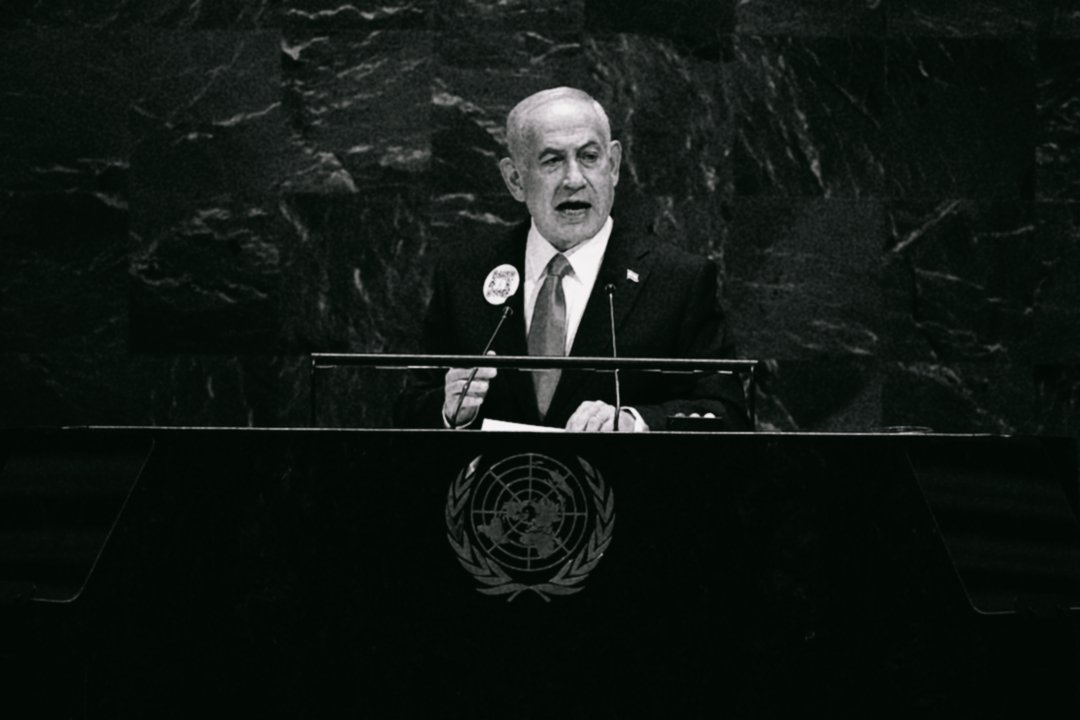
Benjamin Netanyahu, Prime Minister of Israel
On September 24, Israeli Prime Minister Benjamin Netanyahu stood before the United Nations General Assembly to deliver his annual address to the world. During that speech, two arguments stood out to me. The first was that Israel possesses something approaching an eternal claim to the land it occupies, justified through Jewish history, biblical figures, and thousands of years of cultural continuity. The second was that many of those who oppose the actions of his government in Gaza, the West Bank, Iran, and elsewhere are naïve, hypocritical, antisemitic, or worse. Netanyahu repeatedly appealed to history to defend the legitimacy of Israel while using remarkably aggressive language to describe those he considers its enemies. I reject both parts of that argument, although perhaps for reasons that do not fit neatly into the usual debate surrounding Israel and Palestine.
I do not believe that any nation-state possesses a permanent right to the land beneath it. From the earliest human migrations to the borders drawn on maps today, populations have moved across the world in waves. Kingdoms have risen and disappeared, empires have expanded and collapsed, people have migrated voluntarily and involuntarily, and territory has changed political ownership more times than anyone could reasonably count. This does not make every conquest moral or every displacement acceptable; it simply means that human history does not recognize permanent ownership. Netanyahu repeatedly appealed to Jewish history during his speech, telling Syria's president that Jews had lived on the Golan Heights "since the days of Moses," describing Jerusalem as Israel's "eternal capital," and invoking David, Solomon, Isaiah, and Jeremiah before declaring, "That's our land." These statements may communicate something meaningful about Jewish cultural attachment to the land, but they do not establish modern sovereignty. Historical connection and political ownership are not the same thing. He also mocked accusations that Israel is colonial, specifically ridiculing Britain and France for using the term. "For God's sake, they invented the term," he said. Britain and France certainly built enormous colonial empires, but they did not invent conquest, migration, settlement, or imperial expansion; those processes are thousands of years older than either country. In fact, the biblical history Netanyahu himself invokes demonstrates the problem with imagining populations as permanently fixed to one piece of land. Abraham, according to the biblical tradition Netanyahu is appealing to, came from Ur in Mesopotamia. Apparently migration becomes sacred history when your ancestors do it and colonialism when somebody else does. More seriously, however, I think the argument over whether Israel is technically "colonial" is much less important than many people make it. Colonialism has frequently involved exploitation, displacement, violence, and destruction, but it has also been a recurring historical process through which much of the modern political map developed. Calling something colonial does not by itself answer what should happen to the society that exists there today.
Australia, Canada, New Zealand, and the United States are obvious examples. All four developed through settler colonial expansion that caused enormous harm to indigenous populations, and acknowledging their stability today should never require pretending otherwise. They are also successful modern nation-states with functioning institutions, settled systems of government, internationally recognized sovereignty, and national cultures that now exist independently of the colonial processes that created them. Their legitimacy today does not rest on claiming that British settlers possessed an eternal historical right to North America or Australia; it rests on the political reality that these states exist, administer territory, maintain institutions, and are recognized by the international community. This is where I think Netanyahu's historical argument becomes particularly weak. Israel does not need to prove that Jews possessed the land thousands of years ago in order to function as a modern state, and the fact that Jews did live there thousands of years ago does not automatically establish Israeli sovereignty over every piece of territory an Israeli government might claim today.
The modern nation-state is ultimately a political institution rather than an inheritance passed down through ancestry. States possess governments, territory, populations, institutions, and relationships with other states. Recognition matters because sovereignty exists partly through the willingness of other states to treat a government as the legitimate representative of a territory. Kurdistan illustrates the distinction: Kurdish people possess a distinct history, culture, language, and identifiable geographical homeland, but there is no internationally recognized sovereign state of Kurdistan because that cultural and historical identity has not translated into internationally recognized statehood. Israel, by contrast, is unquestionably recognized as a state, although that does not mean the international community recognizes every territorial claim made by the Israeli government. Recognition of Israel and recognition of Israeli sovereignty over particular disputed territories are different questions. This is also why I have never found the phrase "Israel has a right to exist" especially useful. I do not believe any state possesses a metaphysical right to exist forever. Human beings have rights. Populations have rights. People have legitimate interests in personal security, political representation, cultural expression, and self-determination. States are political arrangements created to organize those people, and they divide, merge, collapse, democratize, federalize, lose territory, gain territory, and sometimes disappear entirely. Yugoslavia once existed and no longer does. The Soviet Union once existed and no longer does. Czechoslovakia once existed and no longer does. None of those facts mean that the people who lived within those states lost their human rights when the political institutions surrounding them changed. The same principle applies to Israel, Palestine, the United States, Australia, and every other nation-state. No political arrangement receives an eternal guarantee simply because the people living within it would prefer that it remain unchanged.
That does not mean Jewish Israelis should be expelled from their homes, that Israel should suddenly cease functioning, or that Jewish people do not possess a legitimate right to live safely in the region. Quite the opposite. Israel's strongest claim to continued statehood is not Moses, David, Solomon, or a biblical promise; it is the reality that millions of people live there today and require functioning political institutions today. A durable Israeli state therefore depends less on proving an ancient deed and more on maintaining functioning government, recognized sovereignty, internal political stability, and institutions capable of administering a complicated and diverse population. If Israel wishes to remain a successful nation-state over the long term, properly governing the Jews, Muslims, Christians, Arabs, Druze, and others who live under its authority seems considerably more important than proving who lived on which hill three thousand years ago.
That concern leads directly into the second part of Netanyahu's speech. Netanyahu devoted considerable attention to antisemitism, and antisemitism deserves to be taken seriously. Jewish communities around the world continue to experience hatred and violence directed against them because they are Jewish. Hamas deliberately murdered and kidnapped Israeli civilians on October 7, and antisemitic ideology exists within extremist movements that openly call for violence against Jewish people. There should be no hesitation in identifying that. The problem is that Netanyahu repeatedly weakened his own argument by using accusations of antisemitism against political opponents while employing language that was itself sweeping, hostile, and at times plainly dehumanizing. The clearest example was New York City Mayor Zohran Mamdani. Netanyahu called him the "antisemitic mayor of New York City" and later referred to "Mamdani's Hamas buddies," saying that they would have killed every Israeli had Israel not stopped them. Mamdani has been one of Netanyahu's most severe American critics, and he has accused Israel of genocide and Netanyahu of war crimes. Netanyahu has every right to reject those accusations and challenge Mamdani's statements. What he does not get to do without scrutiny is convert disagreement with Israel into proof of hatred toward Jews. Mamdani is also not an Israeli politician; he is the elected mayor of New York City, sworn into office on January 1, 2026 after being chosen by American voters. A foreign leader came onto American soil, stood in New York City, and used an international platform to associate an elected American official with terrorists who he then said would have exterminated Jews. Regardless of whether someone supports Mamdani politically, I find that deeply inappropriate. Mamdani being Muslim makes that language even more irresponsible. Associating a Muslim-American politician with Hamas without demonstrating an actual connection relies upon the same kind of collective suspicion that Netanyahu is asking the world to reject when it is applied to Jewish people. Anti-Muslim hatred is not somehow less important than antisemitism. Muslims should not be presumed sympathetic to Hamas because they are Muslim any more than Jewish people should be presumed responsible for actions taken by the Israeli government because they are Jewish.
Netanyahu repeatedly blurred these distinctions throughout his speech, moving between Hamas, jihadists, Muslims, critics of Israel, antisemitism, and threats to Western civilization in ways that made each category increasingly difficult to separate from the others. He described Israel as fighting "barbarians," warned about "fanatic jihadists," accused Qatar of financing efforts to make young people hate Israel, America, and the West, and described Turkey as a new "super-spreader" of antisemitic lies. The cumulative effect was not simply a defense of Israel. It was the construction of a broad civilizational enemy into which very different people and political movements could be placed. His repeated references to Nazis create a similar problem. There are obviously historical reasons why the Holocaust occupies an enormous place within Jewish political consciousness, and there are legitimate comparisons to be made between contemporary antisemitic violence and earlier persecution of Jewish people. October 7 was an atrocity. But the Holocaust was not simply another occasion on which Jewish people were attacked; it was a specific attempt by a modern state to systematically exterminate European Jewry. When "Nazi" becomes a general description for sufficiently vicious enemies of Israel, the historical specificity of the Holocaust begins to disappear. The same danger exists with the word "antisemitism." These words should carry enormous moral weight, which is precisely why they should not be expanded until opposition to an Israeli government, hostility toward Netanyahu, Muslim identity, Hamas, jihadism, and antisemitism begin to blend together. If everyone who opposes Israel is eventually treated as an antisemite, the accusation becomes less useful when an actual antisemite appears.
Some of the most striking moments of the speech involved Netanyahu's descriptions of Israeli military power. At one point, he held up a pager while referencing Israel's operation against Hezbollah and said, "Remember the beepers? Well, I can tell you this: Hezbollah certainly remembers them." Later, he asked the diplomats sitting in the General Assembly to imagine what would happen if a one-ton ballistic missile struck the United Nations compound. "It would obliterate the entire compound," he said, adding that two such missiles would "obliterate the U.N." Netanyahu was making a comparison to the roughly one thousand Iranian ballistic missiles he said Israelis had endured, not announcing an intention to attack the United Nations, and that context is important. But context does not make rhetoric meaningless. This was still the prime minister of Israel standing inside the United Nations, after condemning delegates who walked out of his speech as "moral cowards," holding up a device associated with an Israeli attack and then graphically describing the destruction of the institution in which he was speaking. I find that language particularly damaging because Netanyahu is simultaneously asking the world to take Israeli vulnerability seriously. He wants other countries to understand what it feels like when missiles fall on Israeli cities, when civilians are killed, and when extremist organizations openly celebrate violence against Israelis. Those are legitimate concerns. But a leader making that argument should be especially aware of the imagery he uses when discussing violence against other people. Holding up a pager and joking that Hezbollah "certainly remembers" what Israel did with them may appeal to Netanyahu's supporters, but it also communicates something about how casually violence can enter his political rhetoric. Telling delegates to imagine the destruction of the United Nations may have been intended to help them understand an Israeli experience, but following it with the observation that two missiles could destroy the institution entirely inevitably carries a different tone when spoken by a leader whose government is already engaged in multiple regional conflicts.
This contradiction is what stayed with me most after reading Netanyahu's speech. He asks the world to reject the dehumanization of Jewish people while describing others as barbarians. He asks Americans to understand the danger of antisemitic stereotyping while associating a Muslim-American elected official with Hamas. He warns that language directed toward Israel can encourage violence while himself speaking casually about violence and destruction. He invokes thousands of years of Jewish history to argue for political permanence while speaking before an institution built around a modern international order in which borders, recognition, sovereignty, and political agreements determine relations between states. None of this requires denying Jewish history, minimizing October 7, pretending Hamas is harmless, or claiming that Israel has no legitimate security concerns. Jewish historical attachment to the land is real. Antisemitism is real. Islamist extremism is real. Israelis have a right as human beings to live safely in their homes, just as Palestinians do. My disagreement is with the conclusion Netanyahu draws from those realities. Jewish historical suffering does not create an eternal territorial deed. Israeli security does not require describing political opponents as terrorists or barbarians. Opposition to Netanyahu does not become antisemitism merely because Netanyahu says it does, and criticism of Israel does not erase the existence of genuine antisemitism elsewhere.
I ultimately think Netanyahu would make a stronger case for Israel if he relied less on eternity. Israel does not need to have existed since Moses in order for the people living there today to matter. Palestinians do not need to establish that their ancestors possessed an equally ancient deed for their lives to matter either. Political borders change because political institutions are temporary, and the legitimacy of a modern state depends on what it does with the power it possesses now. A successful state governs effectively, maintains order, protects its population, establishes workable relationships with its neighbors, and creates institutions capable of surviving political disagreements without reducing sections of its population or its opponents to permanent enemies. Netanyahu ended his address by invoking the biblical phrase netzach Yisrael lo yeshaker, the eternity of Israel will not falter. I understand the emotional appeal of that idea, particularly within a history that includes exile, persecution, pogroms, and genocide. I simply do not think eternity is something a government can possess. States survive because people continually maintain them, institutions continue functioning, populations accept their authority, and other states continue recognizing them. Israel will ultimately be judged by those standards just like every other country. Its future will not be secured by proving that Moses once stood on the land. It will be secured, if it is secured, by whether the state Israel has built can successfully govern the people who live there now.
About the author
William Harkleroad is the writer and founder of WillNation, an independent journal covering politics, history, geography, culture, travel, and personal reflection.
