
Photo by William Harkleroad
My first time in Kansas was in November 2024, when I drove through the state on my way to Colorado for sightseeing. At that point in my life, I was taking a lot of trips west, usually in search of the landscapes that make that part of the country famous. Colorado had the Rocky Mountains, Utah had its canyons and red rock, and Arizona had desert landscapes unlike anything I had grown up around. Kansas was initially a place between those destinations. I stopped there for food, fuel, and sleep before getting back on the road and continuing west.
It is no secret that Kansas does not have the same kind of scenery as central or western Colorado, Utah, or Arizona. There are no enormous mountain ranges or deep canyons, and much of the state is made up of farmland and prairie. That has given Kansas a reputation for being flat and boring, especially among people whose only experience with the state is driving across Interstate 70. I understood that reputation when I first arrived, but the more time I spent driving through Kansas, the less I agreed with it. I began to notice how enormous the landscape felt precisely because there was so little obstructing it. Instead of looking upward at mountains, I found myself looking outward across ridges, fields, and horizons that seemed impossibly far away.
There is a particular feeling I get driving through the Flint Hills that is difficult to reproduce elsewhere. You can see a ridge far ahead of you and spend several minutes gradually approaching it, wondering what will be visible from the top. When you finally reach it, the landscape opens again and another series of hills appears in the distance. The roads follow the shape of the land, climbing and falling through grassland with views that can stretch for miles in every direction. None of it is especially dramatic in isolation, but together it creates a sense of scale that I think is easy to miss if you are only passing through and waiting for something more obvious to appear.
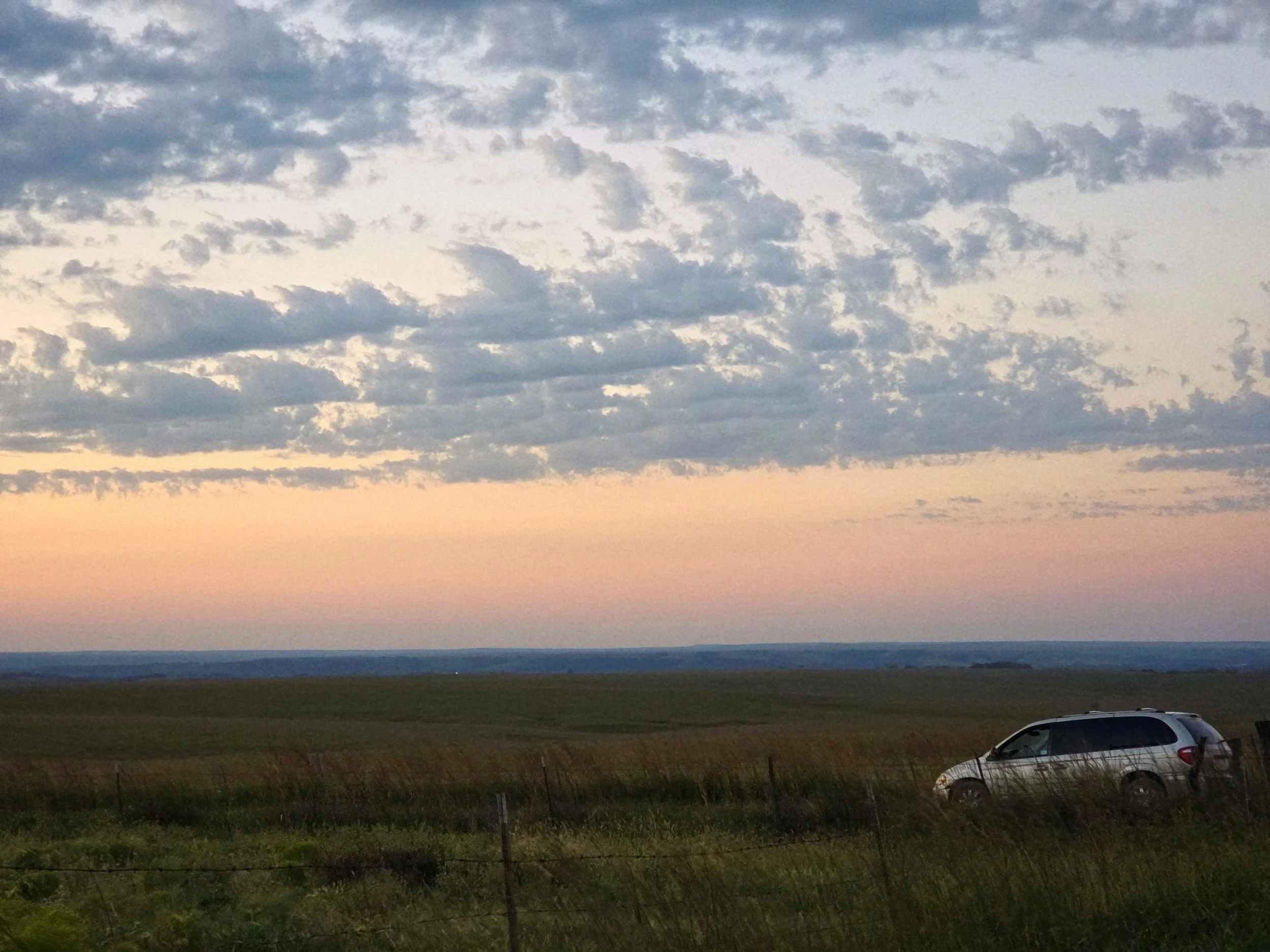
The photograph above was taken in Wabaunsee County, just west of Topeka. Wabaunsee County has become one of my favorite parts of Kansas and, I think, one of the most underrated places in the country. For me, the photo captures the kind of view that I once would have passed without thinking much about and now deliberately go looking for.
Much of Wabaunsee County has that quality. Alma is a small county seat built from the same limestone that appears throughout the Flint Hills, and within minutes of leaving town you can find yourself on gravel roads surrounded by rolling prairie. There are old farmhouses, cattle pastures, limestone buildings, and roads that seem to disappear into the horizon. Kansas does not concentrate its scenery into a handful of famous viewpoints. Some of the best views I have found have been along ordinary county roads where there is no sign telling you to stop and no designated overlook explaining what you are supposed to see. You simply come over a hill, notice the view, and pull over.
I think that is part of why I have grown so attached to Kansas. Its beauty is not based on comparison with places like Colorado because it offers something completely different. A mountain announces itself immediately. The Flint Hills require more attention. Their scale comes from distance rather than height, and their appearance changes constantly with the weather, seasons, and light. A clear afternoon can make the horizon feel endless, while a storm can turn the same open landscape into something completely different. At sunrise and sunset, the lack of anything blocking the horizon means the sky can become the dominant feature of the landscape. Once I began noticing those things, the idea that Kansas was simply flat became increasingly strange to me.
Kansas is still a place that millions of people pass through on their way somewhere else, and I understand why its landscape does not immediately capture everyone. It did not immediately capture me either. What changed was that I eventually stopped treating it as the space between destinations and started looking at what was actually around me. The mountains I was chasing in 2024 are still beautiful, but so is standing on a quiet road in Wabaunsee County and being able to see what feels like half of Kansas stretched out in front of you.
About the author
William Harkleroad is the writer and founder of WillNation, an independent journal covering politics, history, geography, culture, travel, and personal reflection.
